Reparations Report


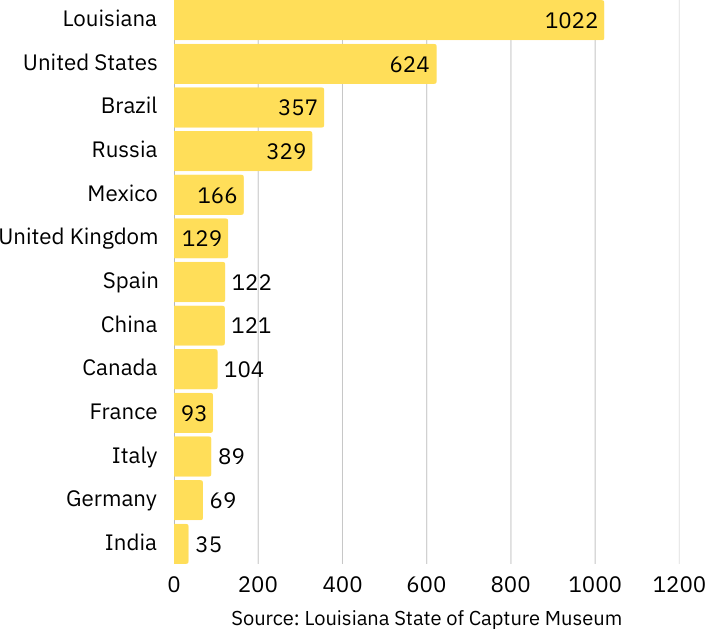
Louisiana (LA.), a state known for its vibrant culture and unique heritage, unfortunately also bears the heavy burden of being one of the most heavily policed and incarcerated states in the country. LA. has the most prisoners per capita in the entire world. The residents of Louisiana, particularly those of color, face an alarming and unsettling reality – frequent, unconstitutional interactions with law enforcement that all too often escalate to violence, leaving individuals with little hope for justice.
Since 2013, residents of Louisiana have filed over 3,000 civilian complaints about police misconduct, of which only 10% were ruled in favor of civilians. Over the same period, we witnessed over 200 lives lost to police violence, with rare instances of accountability.
The impacts of this systemic problem ripple far beyond the initial encounters. Victims of police violence not only have to grapple with the physical injuries and psychological trauma inflicted upon them but must also navigate a criminal legal system steeped in historical racial biases. This system often wrongfully convicts these victims or coerces them into pleading to fabricated resisting arrest charges, further deepening the injustice.
It is in the face of these grim statistics and dire circumstances that the ACLU of Louisiana’s (ACLU-LA) Justice Lab: Putting Racist Policing on Trial™ was established. The Justice Lab is an intensive litigation and storytelling effort to challenge racially discriminatory policing practices and combat police violence against people of color.
In addition to fighting police violence in the courts, ACLU-LA’s Justice Lab is also working to pilot radical redistribution models that create transformative and scalable programs to upend racist policing, mass incarceration, and the criminalization of poverty. To this end, the Justice Lab approached F4GI to help establish an innovative guaranteed income program for families impacted by police violence, funded directly by families who benefited from racial inequities.
The resulting program, the Truth & Reconciliation Guaranteed Income Program, is funded in part by a $1 million commitment from Deacon Buck Close and Gracie Close, whose family profited from the labor of enslaved people.
The Truth & Reconciliation Guaranteed Income Program is the first guaranteed income program in the country to focus specifically on those impacted by police violence. The financial support provided by the program is intended to alleviate some of the economic burdens caused by racial injustice and systemic oppression.
directly affected by police brutality and didn't receive settlement money
monthly payments to understand the impact of poverty on police violence
ACLU-LA’s innovative Truth & Reconciliation program will support 12 people who experienced police violence or harassment and whose cases are no longer active but who did not receive settlement money. The program will deliver cash transfers of $1,000 a month for one year.

The evidence is clear. Guaranteed income has been shown to be an effective public safety intervention that can build a new and more promising future. Providing direct, recurring cash support to formerly incarcerated people aids in preventing future arrests. In the Chicago Future Fund, recidivism rates in the pilot’s first year were 6.67% – and 3% in the second year – compared to the state average of 43%.
As things stand, the companies and consultants currently profiting from the exploitative carceral system can never be trusted to act in the best interest of their survivors. The US currently spends more than twice as much on law and order through police, prisons, and the court system as it does on cash welfare programs. That is precisely why there is no other way to change the system than to change its underpinning economic logic. UBI is the most reasonable step towards this.
We need people with lived experience, people with experience of advocating for survivors with compassion, and people who are accountable to their colleagues and the movement to design the alternatives.
Throughout a special feature on guaranteed income and reparations we edited for Open Democracy, you can hear from academics and practitioners at the forefront of the call for restorative justice. They demonstrate how systems of control, oppression, and exploitation did not die with the end of slavery but instead evolved.
The map is not exhaustive and will continue to grow. If you know of a program that should be added, please contact us.
Policy briefs that build the evidence base for the new frontier of guaranteed income.


Over a 12-month period, 50 recipients of E-TANF will receive an additional $500 per month, while a comparison group of 250 additional recipients of E-TANF will receive an extra $50 per month.


Two year program delivering $500 a month to 305 low-income families with young children in Sonoma County.

A new court date notification tool for residents in LA County
